Preserving Rembrandt for Future Generations
Stephan Knobloch, Head of Art-Technology and Conservation Paintings and Modern Sculpture at the Städel Museum, and Nikki Wright, Bank of America’s International Arts & Culture lead, discuss new findings, the complexities of conservation and the collaboration behind preserving and researching Rembrandt’s masterpiece “The Blinding of Samson”.
The restoration and research project on Rembrandt’s “The Blinding of Samson” is an unusually complex, multi-year undertaking. What is the current status of the project, and what have been the most significant findings or surprises so far – whether regarding Rembrandt’s original painting technique or later interventions in the work?
Stephan Knobloch: At present, we are in the process of removing non-original varnish layers and later overpainting or retouching from the surface of the painting. At the same time, we are conserving the original ground and paint layers. Extensive analytical work has confirmed the techniques typically used by Rembrandt and his workshop. In addition, two compositional changes have been identified: the soldier with the lance originally carried a quiver of arrows over his shoulder, and a soldier’s head was intended for the upper right-hand half of the picture.

Pentimenti revealed by micro-X-ray fluorescence analysis. Another soldier has been added to the underdrawing.

Compresses soaked in solvent are left to act on the varnish and then the remains of the dissolved varnish are removed with cotton swabs.

Changes made by Rembrandt during the painting process: A quiver is painted over with the fur that is visible today.
The project combines state-of-the-art technical investigations with the actual restoration of the painting. To what extent do the results from X-ray imaging, infrared reflectography, microscopy and other analytical methods inform your decisions as a restorer? And what are the most important next steps in the restoration process?
Stephan Knobloch: The analyses enable us, on the one hand, to understand the working methods of the artist and his workshop and, on the other, to reliably distinguish original paint layers from those added later. This is essential for drawing up a conservation and restoration plan. As mentioned above, the most important step is already underway, namely the conservation of the original paint layer. Once this lengthy process has been completed, the painting will be varnished and any gaps in the paintwork filled with retouching. Only reversible materials will be used for this.
Bank of America’s Art Conservation Project supports the preservation of significant works of art around the world. What made Rembrandt’s “The Blinding of Samson” and the Städel Museum’s conservation and research project particularly compelling for the programme? What does supporting a long-term project of this scale mean to Bank of America?
Nikki Wright: The Bank of America Art Conservation Project™ is part of the bank's broader commitment to supporting arts and cultural institutions and helping make culture accessible to the communities they serve. Since 2010, the programme has supported the conservation of more than 15,000 objects in 40 countries.

Stephan Knobloch, Head of Art-Technology and Conservation Paintings and Modern Sculpture, Städel Museum

Nikki Wright, Bank of America’s International Arts & Culture lead

Previous state of Rembrandt’s work
The projects that resonate most strongly are those that combine long-term public impact, a powerful story and a strong connection to place. Rembrandt's “The Blinding of Samson” is an exceptional example. It is one of the Städel Museum's most important works and a masterpiece by one of the defining artists of the Dutch Golden Age.
Our hope is that this project unlocks new scholarship, deepens public engagement and strengthens the connection between people and our shared cultural heritage. A core principle of the programme is that conserved works return to public display, ensuring they remain accessible to current and future generations.
Conservation projects of this kind often take place largely behind the scenes and can unfold over several years. Beyond providing financial support, how does Bank of America engage with the institutions and specialists it supports, and what do you hope will remain as the longer-term impact of this particular project – for the museum, for research and for the public?
Nikki Wright: We have partnered with the Städel Museum on four major conservation projects since 2010, and maintaining an ongoing dialogue with our arts partners is fundamental to the programme.
Conservation is both labour and time intensive, so one of our goals is to help build greater public understanding and appreciation of the vital role it plays in safeguarding cultural heritage. Beyond financial support, we work closely with museum partners to engage clients, employees and communities with the artworks and collections we help conserve.
Looking ahead, we hope this project will leave a lasting legacy for the Städel Museum by generating new insights into Rembrandt's work and broadening engagement with one of the artist's most significant paintings.
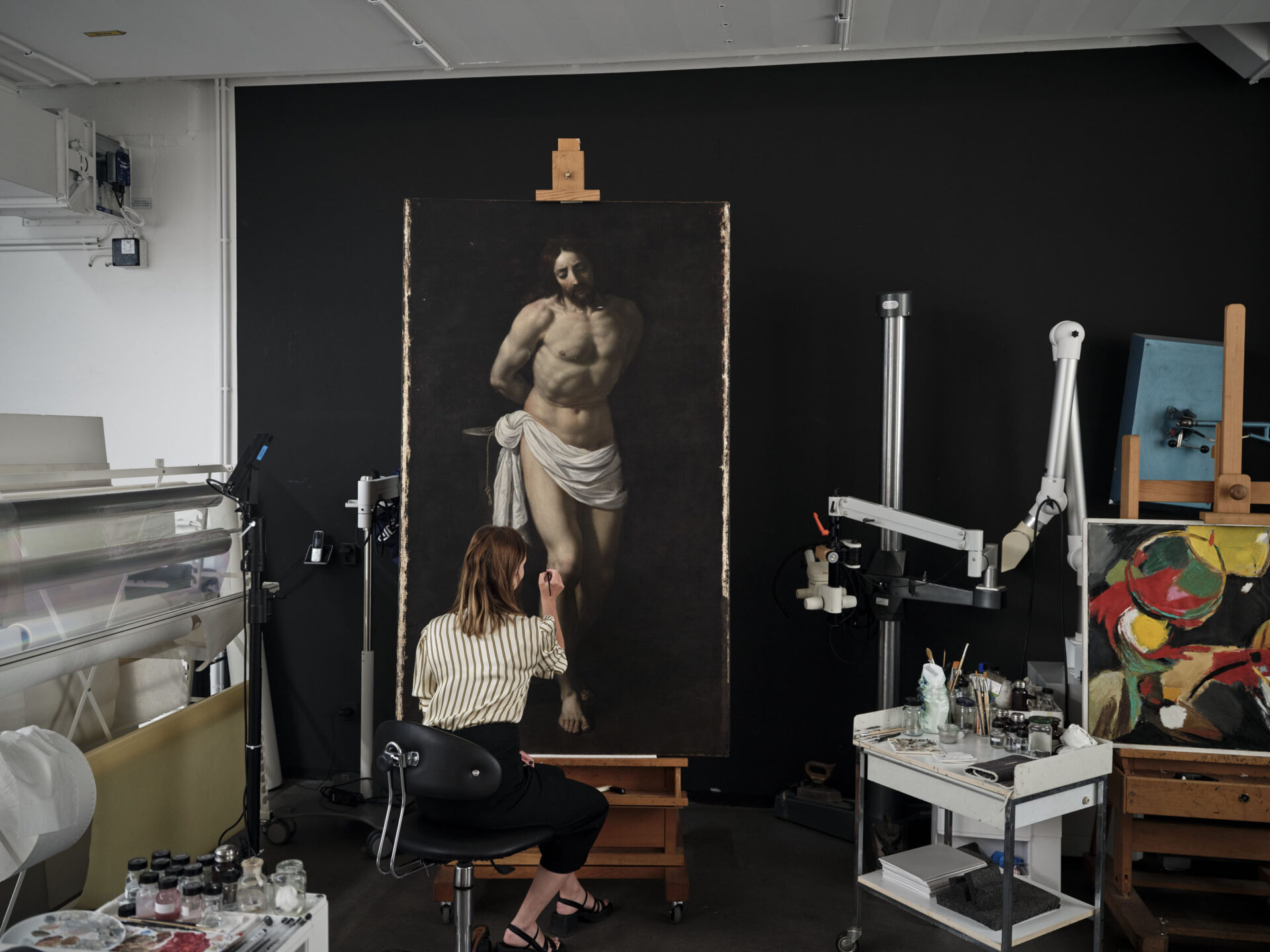
The restoration of Reni's “Christ at the Column” in 2022 was supported by Bank of America's Art Conservation Project.
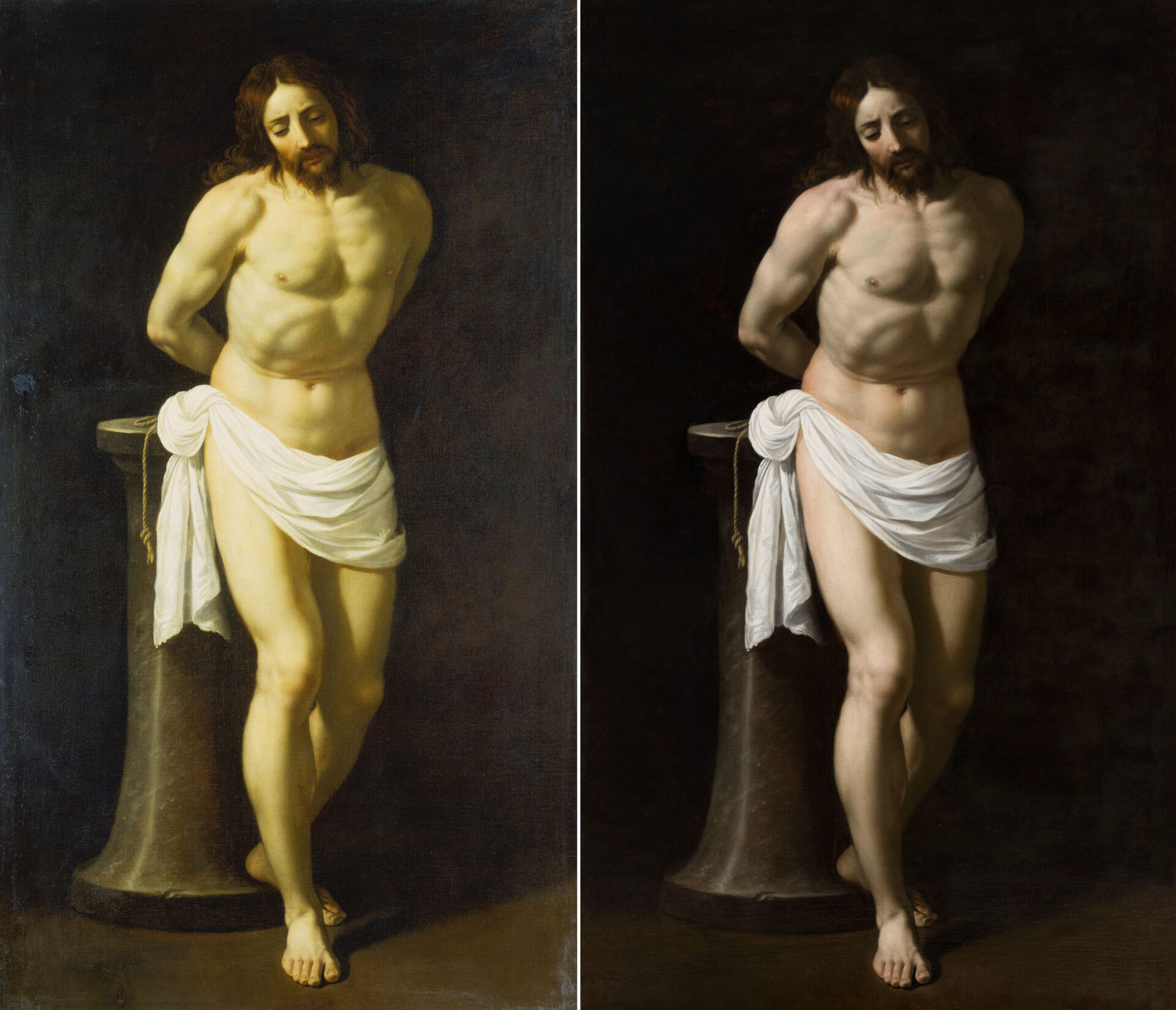
Before and after the restoration of Reni's “Christ at the Column”
This project brings together a museum, conservators and researchers on the one hand and a major corporate supporter on the other. How would you describe the collaboration between the Städel Museum and Bank of America? And, looking ahead to the moment when “The Blinding of Samson” returns to the galleries, what would each of you consider a successful outcome of the project?
Stephan Knobloch: I regard this collaboration as extremely valuable, as the generous support from Bank of America’s Conservation Fund has made it possible for us to carry out this extensive research and restoration project in the first place. The insights gained will be incorporated into Rembrandt research. The greatest success, however, will undoubtedly be the restoration of Rembrandt’s pictorial aesthetic, whilst taking into account the natural ageing of the original paint layers.
Nikki Wright: One of the strengths of the Bank of America Art Conservation Project™ is that it brings together institutions, conservators, researchers and funders around a shared goal: preserving cultural heritage and ensuring it remains accessible to the public.
Success for us is about much more than the completion of the treatment itself. We look forward to seeing “The Blinding of Samson” returned to display, but we are equally excited by the new research and technical insights that will emerge from the project and be shared with the wider museum and conservation community.

Old X-ray detail from the left half of the image

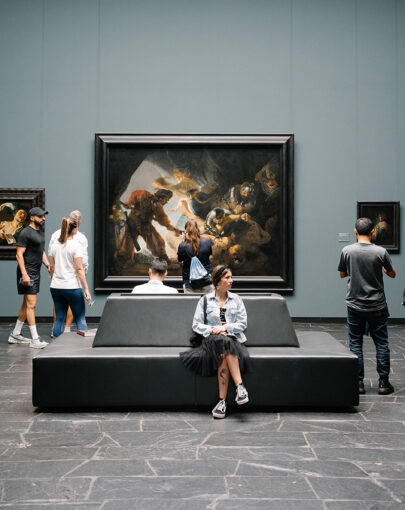
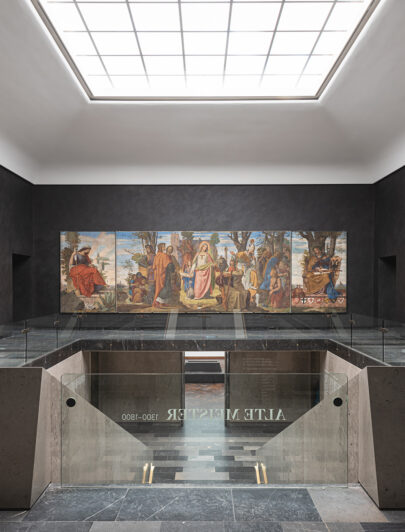
Permanent Collection Display, Old Masters, Städel Museum, photo: Städel Museum – Norbert Miguletz

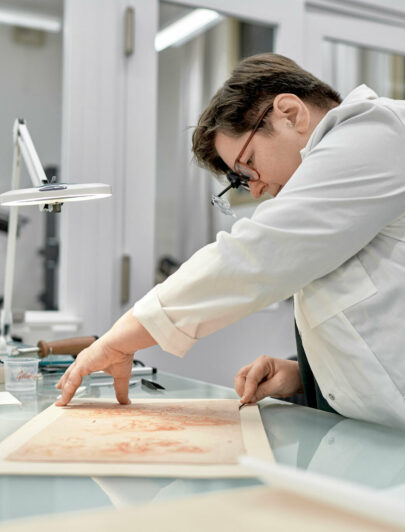
Stephan Knobloch and Linda Schmidt in the conservation studio
Ultimately, the greatest measure of success is public impact. We hope this project deepens understanding of one of Rembrandt's most important works, inspires new conversations and perspectives, and helps new audiences connect with the painting. If the conservation not only preserves the work for future generations but also enriches how people experience and understand it today, that would be a wonderful outcome for everyone involved.
Mehr Stories
-
![]() Rembrandt
RembrandtRembrandts „Die Blendung Simsons“: Ein Meisterwerk voller Spannung und Emotion
Was macht „Die Blendung Simsons“ zu einem Hauptwerk der europäischen Kunstgeschichte?
-
![]() Community-Event zur Rembrandt-Ausstellung
Community-Event zur Rembrandt-AusstellungCall me Rembrandt!
Wie viel Rembrandt steckt in Dir? Rembrandt – ein großer Name, ein weltberühmter Meister, eine Marke – vielleicht ein Influencer? Das erfahrt ihr bei unserem exklusiven Community-Event am 12. November – bewerbt euch für einen der begehrten Plätze!
-
![]() Hinter den Kulissen
Hinter den KulissenWie wird aus einem „Alten Meister“ ein Podcast?
„Blinded by Rembrandt“ – die Podcast-Serie mit Michel Abdollahi: Vier Folgen zu nur einem Bild.

Newsletter
Wer ihn hat,
hat mehr vom Städel.
Aktuelle Ausstellungen, digitale Angebote und Veranstaltungen kompakt. Mit dem Städel E-Mail-Newsletter kommen die neuesten Informationen regelmäßig direkt zu Ihnen.


Beliebt
-
![]() Städel Digital
Städel DigitalDie Zukunft des Museums beginnt jetzt
Pamela Rohde und Chantal Eschenfelder verraten im Interview die Idee hinter dem großen Städel KI Festival.
-
![]() Rembrandt
RembrandtRembrandts „Die Blendung Simsons“: Ein Meisterwerk voller Spannung und Emotion
Was macht „Die Blendung Simsons“ zu einem Hauptwerk der europäischen Kunstgeschichte?
-
![]() Der Film zur Ausstellung
Der Film zur AusstellungElmgreen & Dragset. Stillleben mit Gemüse
Die Künstler sowie die Kuratorinnen der Ausstellung geben Einblicke in den Dialog, den die Skulpturen und Installationen mit der Architektur und der Sammlung des Hauses eingehen.
-
![]() Städel Mixtape
Städel MixtapeBlinky Palermo – Blaues Dreieck, 1969
Ein Kunstwerk – ein Soundtrack: Der Podcast von Städel Museum und ByteFM.
-
![]() Blick hinter die Kulissen
Blick hinter die KulissenRückkehr zweier Meisterwerke ins Licht
Restaurierung zweier Meisterwerke: Die Flémaller Tafeln erstrahlen in neuem Licht
-
![]() Bruegel. Printed
Bruegel. PrintedBruegels Druckgrafiken: witzig, überraschend, klug.
Wie trugen Bruegels Grafiken zu seinem Erfolg bei? Und warum begeistern sie bis heute? Kuratorin Astrid Reuter gibt Antworten.
-
![]() Gastkommentar
GastkommentarGastkommentar: Die Kunst zu widerstehen
Was sieht ein Stoffwechselforscher in den Werken der Städel Sammlung?
-
![]() Elmgreen & Dragset
Elmgreen & DragsetNeue Perspektiven in vertrauten Räumen
Der Raum als Arbeitsmittel: Wie das Künstlerduo Elmgreen & Dragset die Regeln vertrauter Orte freilegt
-
![]() Neuerwerbung
NeuerwerbungEin tierisch guter Neuzugang im Städel Garten
Ein neues Zuhause für Fritz Melis' „Truthennen“
-
![]() Monets Küste
Monets KüsteVom Fischerdorf zum Mythos
Die Kuratoren der Ausstellung im Interview zur Faszination Étretats
-
![]() Alte Meister
Alte MeisterNach 100 Jahren wieder vereint
Die Erwerbung der Altenberger Madonna ist eine Sternstunde für das Städel.
-
![]() Digitales Archiv
Digitales ArchivVon der Archivbox ins Netz
Das Projektteam des digitalen Roederstein-Jughenn-Archivs erläutert im Interview die Entstehung, Ziele und Besonderheiten des Online-Archivs
-
![]() Monets Küste
Monets Küste„Ich werde versuchen, es anders zu machen“ – Claude Monet in Étretat
Monet widmete dem Küstenort rund 80 Gemälde. Was faszinierte ihn so sehr an Étretat?
-
![]() Alte Meister
Alte MeisterVon Paris nach Frankfurt
Ein hinreißendes Gemälde Laurent de La Hyres erweitert die Städel Sammlung – und erzählt von den Anfängen, als Paris zur Metropole der Malerei wurde.